
“Imagine owning a building where a small crack appears in one of the walls.”
Repairing it today would be quick, inexpensive, and relatively straightforward. Instead, the repair is postponed. Weeks become months. Months become years.
The crack grows larger. Water begins to seep in. Structural damage follows. Eventually, what could have been fixed with a simple repair turns into a costly renovation.
Cybersecurity works much the same way.
Small security issues that are ignored today rarely disappear. They accumulate over time, quietly increasing an organization’s exposure until they become expensive, disruptive, or even catastrophic.
This accumulation of unresolved security issues is known as Security Debt.
What Is Security Debt?
Security debt refers to the security risks that build up when organizations postpone or overlook necessary security improvements. Just as financial debt grows with interest, security debt becomes more costly the longer it remains unresolved. It doesn’t happen overnight.
Instead, it accumulates everyday decisions made in the interest of saving time, reducing costs, or keeping business operations moving. Unfortunately, attackers are often the first to notice these unresolved weaknesses.
How Security Debt Builds Up
Security debt rarely begins with a major mistake. More often, it starts with small decisions such as:
- “We’ll patch it next month.”
- “That server is still working, we’ll replace it later.”
- “We’ll review user access during the next audit.”
- “We’ll update that application after the current project.”
Each decision may seem reasonable on its own. Together, they create an environment where risk quietly grows.
Legacy Systems: Reliable, Until They Aren’t

Many organizations continue relying on legacy systems because they remain critical to business operations. Replacing them can be expensive, time-consuming, and operationally disruptive.
However, older systems often lack modern security features, support outdated protocols, and become increasingly difficult to secure. The longer they remain in production without modernization, the greater the risk they introduce.
Unsupported Software
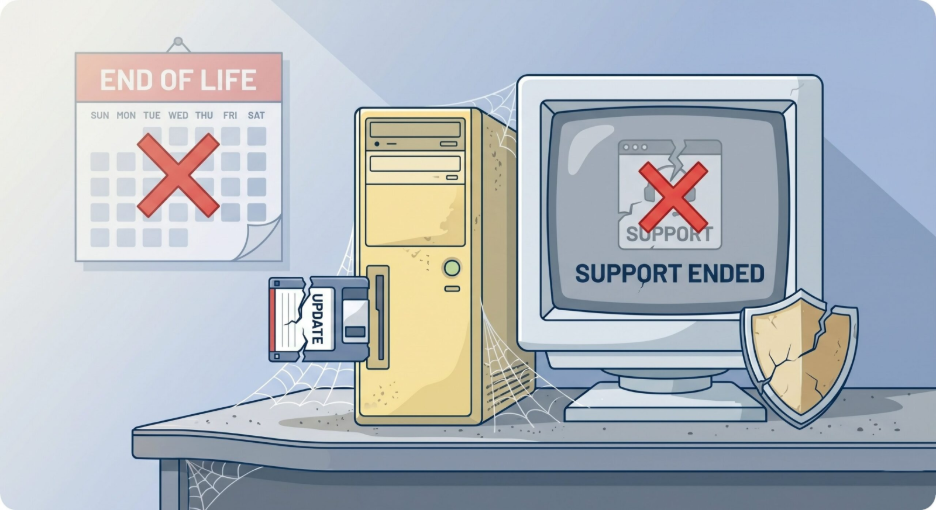
Every software product eventually reaches the end of its lifecycle. When vendor support ends, security updates stop as well.Any newly discovered vulnerability may remain permanently unpatched, leaving organizations responsible for protecting software that no longer receives security fixes.
Continuing to rely on unsupported software is similar to driving a vehicle after the manufacturer has stopped producing replacement parts. Eventually, the risks outweigh convenience.
Deferred Patching
Organizations delay patching for many reasons:
- Avoiding downtime
- Maintaining application compatibility
- Limited maintenance windows
- Resource constraints
While these concerns are understandable, every delayed update extends the window of opportunity for attackers.Many high-profile cyber incidents have exploited vulnerabilities for which security patches were already available.
Sometimes the greatest risk isn’t an unknown vulnerability, it’s a known one that was never addressed.
Technical Debt Becomes Security Debt
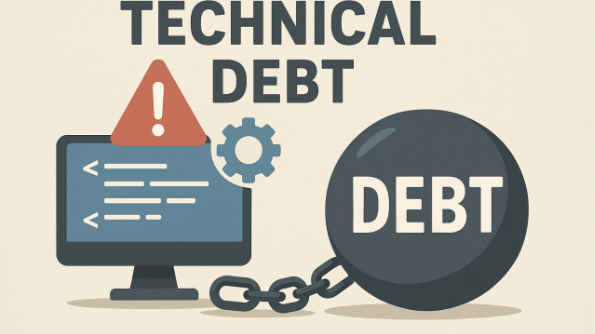
Developers often refer to technical debt as the cost of taking shortcuts during software development. Over time, these shortcuts become harder and more expensive to fix. Security debt follows the same principle.
Temporary exceptions become permanent. Security improvements are continually postponed. Processes become outdated. Configurations drift from secure baselines.
Eventually, security teams spend more time managing accumulated risk than preventing new threats.
The Business Impact
Security debt is often viewed as a technical issue. In reality, it’s a business risk. As security debt grows, organizations may experience:
- Increased exposure to cyberattacks
- Higher remediation costs
- Operational disruptions
- Regulatory and compliance challenges
- Reduced customer trust
- Greater pressure during audits
The longer these issues remain unresolved, the more difficult—and expensive—they become to address.
Managing Security Debt
Like financial debt, security debt cannot always be eliminated overnight. It can, however, be managed through a structured, risk-based approach. Organizations should:
- Maintain an inventory of legacy systems and unsupported software.
- Prioritize vulnerabilities based on business risk.
- Establish realistic patch management timelines.
- Review technical debt during security and architecture discussions.
- Modernize critical systems where feasible.
- Track security exceptions and regularly reassess their necessity.
Managing security debt is not about fixing everything immediately. It’s about ensuring today’s compromises don’t become tomorrow’s security incidents.
Every organization carries some level of security debt. The difference lies in whether it is actively managed or quietly ignored. The most dangerous vulnerabilities are not always the newest ones. Often, they are the ones that have been waiting for attention for months or even years. Cybersecurity isn’t just about responding to emerging threats.
It’s also about addressing yesterday’s unfinished work before it becomes tomorrow’s breach. Because security debt, much like financial debt, only becomes more expensive the longer it is left unpaid.