
Vulnerability & Application Security
Attack Surface Management: You Can’t Protect What You Don’t Know Exists
Imagine locking every door and window in your house before leaving for vacation. You double check the front door. The back door is secure. Every window is locked. The alarm system…

Imagine locking every door and window in your house before leaving for vacation. You double check the front door. The back door is secure. Every window is locked. The alarm system is armed. You feel confident that your home is protected. But what if there was another door you forgot existed?
A side entrance built years ago. A window left open in the attic. A spare key hidden outside that everyone forgot about. Suddenly, all the security measures you’ve carefully implemented don’t seem quite effective. This is exactly the challenge many organizations face today.
The Digital Footprint That’s Growing Faster Than You Think
Modern businesses are constantly expanding their digital presence. New cloud environments are deployed in minutes. Teams adopt SaaS applications to improve productivity. Developers spin up test environments. Marketing launches new websites and campaign domains.
Every new asset creates an opportunity for innovation. Unfortunately, it can also create an opportunity for attackers. The problem isn’t that organizations lack security controls. The problem is that they often don’t have complete visibility into everything they own. And attackers know it. While security teams focus on protecting critical systems, attackers are searching for the forgotten ones.
- The abandoned subdomain.
- The unused cloud server.
- The forgotten development environment.
- The public-facing application nobody remembers creating.
These overlooked assets are often the easiest way into an organization.
What Is Attack Surface Management?
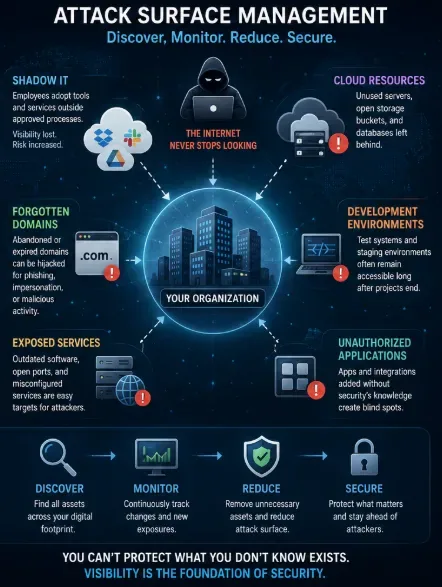
Attack Surface Management (ASM) is the practice of continuously identifying, monitoring, and reducing the assets that attackers could potentially exploit. Think of it as creating a live map of your organization’s digital footprint. Instead of asking, “How do we protect our systems?” ASM asks a more fundamental question: “Do we actually know every system that exists?”
The answer is often surprising. Many organizations discover internet-facing assets, cloud resources, and applications they didn’t realize were still active. In cybersecurity, visibility is not a luxury. It is the foundation of security.
Shadow IT: The Technology Nobody Told Security About
Picture an employee who needs to share large files with a client. The approved process is slow, so they sign up for a free cloud storage platform and begin using it immediately. The task gets completed. The client is happy. No security alerts are triggered. Everything appears fine. Except now company data exists in a platform the security team doesn’t know about. This is known as Shadow IT.
Shadow IT grows when employees adopt tools and services outside established processes. While the intention is usually productivity, the result is reduced visibility and increased risk. The most dangerous assets are often not the ones protected by security teams. They’re the ones security teams don’t know exist.
Forgotten Domains: Yesterday’s Project, Today’s Security Risk
Organizations launch websites all the time; Marketing campaigns, Product launches, testing environments, Regional initiatives.
Over time, some of these domains are abandoned and forgotten. But attackers don’t forget. An expired domain or neglected subdomain can become a valuable asset for cybercriminals. It can be used to impersonate the organization, host malicious content, or support phishing campaigns that appear legitimate. What started as a short-term business initiative can become a long-term security exposure.
The Cloud Resource That Nobody Turned Off
Cloud technology has transformed the way businesses operate. Need a server? Create one in minutes. Need additional storage? A few clicks and it’s available. Need a testing environment? Deploy it instantly.
The ease of cloud adoption is one of its greatest strengths. It’s also one of its biggest risks. Many organizations create resources quickly but forget to remove them when they’re no longer needed. An unused virtual machine may still be accessible from the internet. A storage bucket may contain sensitive information. A development database may still be running months after a project ended.
The danger isn’t the cloud itself. The danger is forgetting what’s been left behind.
The Internet Never Stops Looking
Attackers no longer search manually for vulnerable systems.
Automated tools continuously scan the internet looking for exposed services, outdated software, and misconfigured systems. Every exposed asset becomes part of a global catalog waiting to be discovered; An outdated VPN gateway, unsecured API, forgotten remote access portal , vulnerable web application. It only takes one overlooked system to create an entry point into an organization. While security teams sleep, automated scans continue around the clock. The internet never stops looking.
Why Asset Inventories Are No Longer Enough
For years, organizations maintained spreadsheets listing their servers, applications, and infrastructure. Unfortunately, modern environments change too quickly. New cloud resources appear daily. Developers deploy new applications. Business units adopt new services. Third-party integrations expand continuously. A spreadsheet created six months ago may already be incomplete. Attack Surface Management recognizes that asset visibility is not a one-time project. It is an ongoing process.
Visibility Before Protection
Organizations often invest heavily in firewalls, endpoint protection, monitoring tools, and security awareness programs. These investments are important. However, even the best security controls cannot protect assets that nobody knows exist. Before organizations can defend their digital environments, they must first understand them.
That means continuously discovering assets, monitoring changes, reducing unnecessary exposure, and ensuring forgotten systems do not become future security incidents.
The biggest cybersecurity risk isn’t always a sophisticated attacker. Sometimes it’s a forgotten asset quietly sitting in the background; an abandoned domain, an unused cloud server, unauthorized application, An exposed service nobody remembered was still online.
Attackers succeed not because organizations lack security controls, but because they find the systems those controls never reached.Attack Surface Management addresses a simple but powerful reality: You can’t protect what you don’t know exists.
And in today’s digital world, knowing what exists may be the most important security control of all.
Related articles
All insights
The Rise of Shadow APIs: The Hidden Connections Attackers Are Searching For
The API You Cannot See Could Become the Door Attackers Walk Through Your organization has invested in cybersecurity. Firewalls are configured. Endpoints are protected. Employees…

Beyond the Fingerprint: Anthropic’s 500 Bug Blowout and the New Security Order
While the industry has long been locked in a cycle of tactical escalation, the introduction of reasoning-based analysis marks a transition from simple pattern recognition to…

How Poor UI/UX Design Creates Cybersecurity Risks
Cybersecurity is often viewed through a purely technical lens such as firewalls, encryption, intrusion detection systems, and access controls. However, an equally important and…