
Identity & Access Security
The Passwordless Future: Are Passkeys Finally Ending the Password Era?
The Password That Was Never There You woke up, checked your emails, logged into your company dashboard, reviewed your financial reports. Everything looked normal. But somewhere…
The Password That Was Never There
You woke up, checked your emails, logged into your company dashboard, reviewed your financial reports.
Everything looked normal.
But somewhere else in the world, an attacker was already inside.
No malware was installed, no vulnerability was exploited, no firewall was bypassed.
They simply used your password.
A password that was:
- reused from another account,
- stolen from a previous data breach,
- captured through phishing,
- or guessed through automated attacks.
This is the uncomfortable reality of modern cybersecurity.
The biggest weakness in many organizations is not always technology. It is the way humans authenticate.
For decades, passwords have been the digital keys protecting our identities. But those keys have a problem.
They can be copied, stolen, guessed, or shared. And attackers know this.
According to the evolving threat landscape, stolen credentials remain one of the most valuable assets in the underground cybercrime economy.
So, what happens when we remove the password entirely?
What happens when your identity is protected not by something you remember, but by something you can prove?
This is the idea behind passkeys.
The End of the Password Problem?
Passwords were never designed for the world we live in today.
When passwords were first introduced, people only needed to remember a few credentials.
Today, an average person manages dozens of online accounts:
- Banking
- Social media
- Cloud platforms
- Workplace applications
- Online services
The result? Password overload.
People create shortcuts:
- Using the same password everywhere
- Creating predictable passwords
- Writing passwords down
- Sharing passwords with colleagues
- Ignoring security recommendations
Attackers take advantage of these human behaviors.
A stolen password from one website can become the entry point into multiple systems.
This is why cybersecurity is shifting from password-based authentication to identity-based authentication.
And passkeys are leading that transformation.
What Are Passkeys?
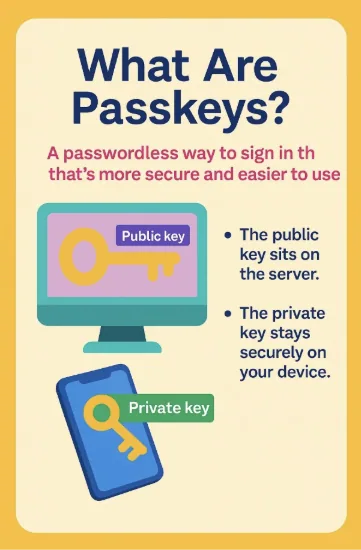
Passkeys are a passwordless authentication technology designed to provide a safer and simpler way to verify identity.
Instead of proving who you are by typing a password, passkeys use public-key cryptography. This means your authentication relies on two connected but different keys:
Private Key – A secret stored securely on your device. It never leaves your phone, computer, or security key.
Public Key – A shared with the service you want to access.
The website or application stores this key to verify your identity during login.
The important difference? Even if an attacker compromises the service provider, they cannot steal your private key because it never exists on their servers. There is no password database waiting to be breached.
How Do Passkeys Actually Work?
Passkeys are based on the FIDO2 standard, an authentication framework developed by the FIDO Alliance with support from major technology companies.
The process happens in three main stages.
1. Creating a Passkey
When you create a passkey:
Your device generates a unique cryptographic key pair.
The private key stays protected inside your device’s secure hardware.
The public key is sent to the website or application.
The service now knows how to verify you without ever knowing your secret.
2. Authenticating During Login
When you attempt to log in:
The website sends a unique challenge to your device.
Your device asks you to verify yourself using:
- Fingerprint
- Facial recognition
- Device PIN
- Security key
After verification, your device uses the private key to create a digital signature.
The website checks this signature using your public key.
If everything matches, access is granted. No password. No OTP code. No secret information being transmitted.
3. Staying Protected Against Phishing
This is where passkeys become extremely powerful.
Traditional authentication relies on users recognizing fake websites.
Attackers create convincing copies of:
- Banking portals
- Microsoft login pages
- Google accounts
- Corporate systems
Users enter their credentials. Attackers collect them.
Passkeys work differently. They are tied to the legitimate website where they were created.
A fake website cannot use your passkey because the cryptographic verification will fail.
The authentication process knows the difference between the real website and a convincing copy.
Why Phishing-Resistant Authentication Matters
Phishing has evolved. Attackers no longer send obvious emails with spelling mistakes.
Modern phishing campaigns use:
- Fake login portals
- AI-generated messages
- Real-time credential harvesting
- Social engineering
- MFA bypass techniques
Even Multi-Factor Authentication, while still valuable, is not immune.
Attackers have developed methods such as:
- MFA Fatigue Attacks – Attackers repeatedly send authentication requests until users accidentally approve one.
- Real-Time Phishing Attacks – Attackers create fake login pages that capture usernames, passwords, and even MFA codes.
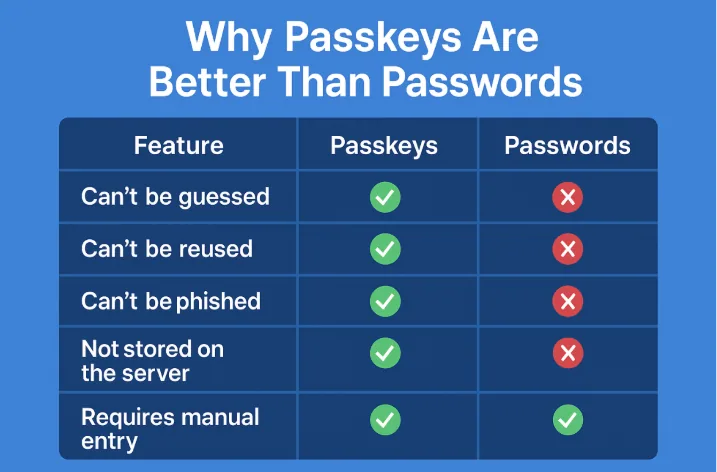
Passkeys address this problem because the authentication process is cryptographically linked to the legitimate service. The user does not provide a secret that an attacker can capture.
Passkeys vs Passwords vs MFA
| Method | Strengths | Weaknesses / Challenges |
| Passwords | ✔ Simple to use ✔ Supported everywhere | ✘ Can be stolen ✘ Often reused ✘ Vulnerable to phishing ✘ Requires regular management |
| Multi-Factor Authentication (MFA) | ✔ More secure than passwords alone ✔ Adds an extra verification layer | ✘ Some methods can still be bypassed ✘ Users can be tricked into approving requests |
| Passkeys | ✔ Resistant to phishing ✔ No passwords to steal ✔ Faster authentication ✔ Strong cryptographic protection | ✘ Requires user adoption ✘ Requires device support ✘ Older systems may need updates |
Why Businesses Should Care About Passwordless Authentication
For organizations, passkeys are not only about convenience. They address one of the biggest cybersecurity challenges:
Identity compromises
A compromised employee account can give attackers access to:
- Corporate emails
- Cloud environments
- Internal applications
- Customer information
- Financial systems
Passkeys can become an important security control within:
- Zero Trust architectures
- Identity and Access Management (IAM)
- Privileged Access Management (PAM)
- ISO/IEC 27001-aligned security programs
Strong identity protection is becoming the new security perimeter.
The Challenges of Moving Beyond Passwords
Although passkeys provide major security benefits, organizations must plan carefully.
- Legacy Application Compatibility
Many older systems still depend on passwords.
Organizations need migration strategies to gradually introduce passwordless authentication.
- User Awareness
Employees need guidance on:
- Creating and using passkeys
- Recovering access
- Protecting devices
- Reporting suspicious activity
Security changes succeed when people understand the reason behind them.
- Identity Lifecycle Management
Organizations must consider:
- Employee onboarding
- Employee departures
- Lost devices
- Device replacement
- Access reviews
Removing passwords does not remove the need for strong identity governance.
Are Passwords Really Disappearing?
The answer is: Not immediately.
Passwords have existed for generations, and millions of systems still depend on them.
However, the security industry is moving toward a future where passwords become less important.
The goal is not simply to create stronger passwords, it is to eliminate the need for passwords wherever possible.
The Future of Authentication: Proving Who You Are
Cybersecurity is entering a new era.
The question is changing.
From: “What is your password?”
To: “Can you prove your identity securely?”
Passkeys represent more than a new login method.
They represent a shift toward a future where digital identity is protected through cryptography rather than human memory.
Because the most secure password may be the one that no longer exists.
Related articles
All insights
Why Passwords No Longer Matter: The Rise of Infostealer Malware and Session Hijacking
“Your password is strong. It uses 16 characters, symbols, numbers, and uppercase letters. You even enabled Multi-Factor Authentication. You’re safe… right?” Not necessarily. For…
The Rise of Biometric Hacks
The Rise of Biometric Hacks: How Fingerprints and Faces Can Be Stolen When Convenience Becomes Risky It was a normal Tuesday morning in a busy tech office. A staff member unlocked…
Identity Security vs AI-Driven Threats
Securing the Future How Identity Security Protects Against AI-Driven Threats Introduction A succession of high-profile breaches worldwide has shown that even advanced economies…