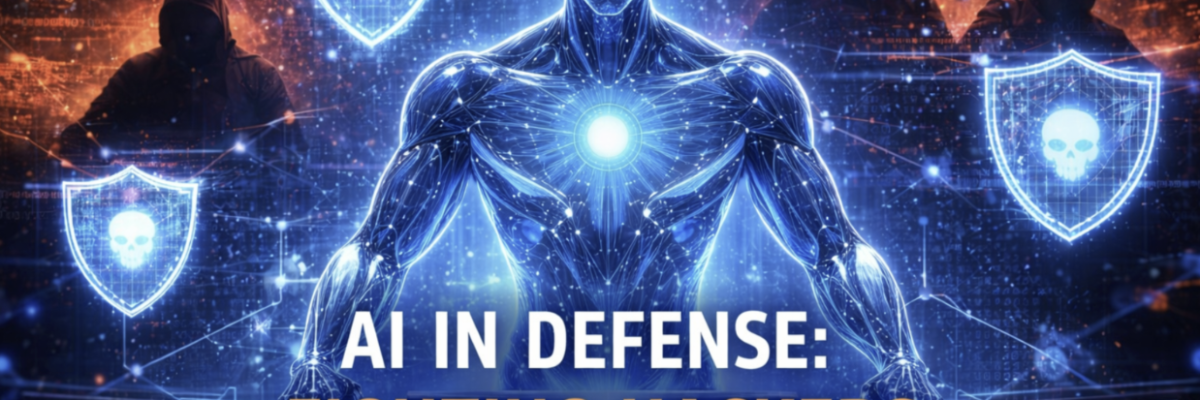
AI in Defense: Fighting Hackers with Hackers
February 9th, 2026 - Written By CyberLabsServices
It was just past midnight when the security dashboard blinked to life. Thousands of login attempts poured in from unusual locations, files were being accessed at speeds no human could manage, and something about the network traffic didn’t feel right.
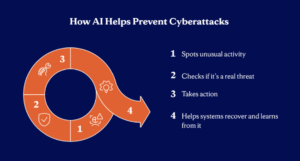
But no human analyst had raised an alert yet. Behind the scenes, a quiet digital guardian had already recognized the anomaly. An AI system, trained on millions of past attacks, was silently tracing the threat, analyzing patterns, and deploying countermeasures, all before anyone in the security operations center had even finished their coffee.
This was not a drill. This was the new frontier of cybersecurity: fighting hackers with hackers.
The Rise of AI in Cybersecurity
The world of cyber attacks is evolving faster than ever. Hackers no longer act alone. They use automated scripts, bots, and even AI to probe, infiltrate, and exploit vulnerabilities. In this environment, traditional defenses like firewalls, signature-based antivirus, and human monitoring are struggling to keep pace.
Enter AI: systems capable of learning from past attacks, recognizing subtle anomalies, and responding in real time. These digital defenders can predict threats, neutralize malware, and even anticipate hackers’ next moves, all at a speed humans cannot match.
The Zero-Day Dilemma
One of the most dangerous threats AI combats is the zero-day attack, a vulnerability unknown to anyone outside the hacker’s mind. By the time humans identify it, the damage is often done: sensitive data stolen, systems disrupted, and trust shattered.
AI, however, can spot unusual behavior patterns long before the exploit is officially recognized.
In the case of our midnight breach, the AI detected irregular login sequences, unusual file access speeds, and network anomalies that matched no known pattern but were unmistakably malicious. It acted immediately, isolating affected systems and neutralizing the threat before any critical data was touched.
AI vs. Hackers: The New Battlefield
The modern cybersecurity battlefield is no longer just human vs. Human. It’s AI vs. AI, AI vs. human, and everything in between.
- Rapid detection: AI systems can process thousands of logs per second, spotting irregularities humans would miss.
- Automated response: Threats can be contained, suspicious accounts disabled, and malware quarantined in real time.
- Predictive analysis: By analyzing attack patterns, AI can anticipate the next move, creating a proactive defense rather than a reactive one.
Yet this power comes with its own risk. The same AI techniques that protect can also be weaponized by attackers, creating an ongoing cat-and-mouse game where speed and intelligence are everything.
The Human-AI Partnership
Despite its capabilities, AI does not replace human analysts. Instead, it amplifies their effectiveness.
Security teams receive actionable insights instantly, allowing them to focus on strategic decisions, incident analysis, and threat hunting.
In this partnership, AI handles the speed and scale, humans handle judgment and context – a combination that can finally keep pace with modern cyber threats.
The Flipside of AI Defense
AI is powerful but it’s not perfect. Organizations need to understand its limitations.
- Data Dependency: AI can only be as good as the data it’s trained on. Poor or incomplete datasets can lead to missed threats.
- False Positives: Over-sensitive systems may flag benign activities as malicious, leading to alert fatigue.
- Adversarial AI: Hackers can trick AI with carefully designed attacks, creating new vulnerabilities.
- Ethical and Privacy Concerns: AI monitoring involves analyzing massive amounts of personal and corporate data, raising compliance and privacy issues.
Despite these challenges, AI remains a vital tool in modern cybersecurity, especially when paired with human oversight.
The Future of AI Defense
Looking ahead, AI’s role in defense is expected to grow even more sophisticated.
- Autonomous response systems that neutralize attacks without human intervention.
- Threat prediction models that forecast attacks before they occur.
- Integration with global threat intelligence networks, allowing AI systems to share learnings across organizations.
- Cybersecurity simulations and “war games” where AI can train itself by mimicking hacker behavior.
In short, AI is no longer a luxury. It’s becoming the backbone of cybersecurity strategy for organizations worldwide.
What We Learn from the Midnight Battle
- AI is no longer optional in cybersecurity. It is essential.
- Organizations must provide AI systems with quality data and continuous training.
- The human-AI partnership is critical: technology alone is not enough.
- Even the most sophisticated threats can be mitigated if detection is fast and response is precise.
By the time the analysts arrived the next morning, the breach had already been contained.
No data is lost. No alarm calls. Just another quiet victory in the invisible war between hackers and the AI systems standing guard.
In a world where attacks are faster, smarter, and more automated than ever, AI has become the frontline defender we didn’t know we needed, fighting fire with fire, one zero-day at a time.