
Cybersecurity Myths You Should Stop Believing
January 30th, 2026 - Written By CyberLabsServices
As technology becomes more integrated into our daily lives, cyber threats continue to grow in both scale and sophistication. Despite this, many individuals and organizations still rely on outdated assumptions about cybersecurity. These myths create blind spots that attackers are quick to exploit.
Understanding what isn’t true about cybersecurity is just as important as knowing best practices. Below are the top 10 cybersecurity myths, explained in depth, along with the real risks they hide.
-
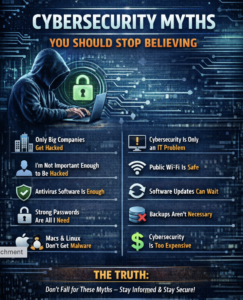
Cyberattacks Only Target Big Companies
A common belief is that hackers focus exclusively on large enterprises because they offer higher financial rewards.
The reality:
While large organizations do attract attention, small businesses are often more vulnerable and therefore more appealing. Many lack dedicated security staff, regular security assessments, or proper incident response plans. Automated attack tools continuously scan the internet for exposed systems, outdated software, and weak credentials regardless of company size.
In fact, a single successful attack on multiple small organizations can be more profitable for attackers than targeting one heavily protected enterprise.

-
I’mNot Important Enough to Be Hacked
Many individuals believe their digital footprint is too insignificant to attract attackers.
The reality:
Cybercriminals don’t target people based on status or popularity. They target data. Personal email accounts, online banking access, social media profiles, and cloud storage all contain information that can be exploited, sold, or used to impersonate you.
Even worse, compromised personal accounts are often used as entry points into corporate networks, making every individual a potential stepping stone in a larger attack.
-
Antivirus Software Is Enough Protection
Antivirus software is often viewed as a complete security solution.
The reality:
Traditional antivirus primarily detects known threats using signatures. Modern attacks frequently use fileless malware, living-off-the-land techniques, and zero-day vulnerabilities that antivirus tools may not recognize.
Effective cybersecurity relies on a layered approach that includes endpoint protection, regular updates, secure configurations, network monitoring, backups, and user education. Antivirus is only one piece of the puzzle.
-
Strong Passwords Are All You Need
Strong passwords are widely recommended and for good reason.
The reality:
Even the strongest passwords can be compromised through phishing attacks, data breaches, keylogging malware, or password reuse across platforms. Once stolen, attackers can use automated tools to test credentials across hundreds of websites in seconds.
Multi-factor authentication (MFA) dramatically reduces this risk by requiring an additional verification step, such as a code or biometric factor, making stolen passwords far less valuable.
-
Macs and Linux Systems Don’t Get Malware
There is a long-standing belief that non-Windows systems are immune to cyber threats.
The reality:
No operating system is immune. While Windows systems are targeted more frequently due to market share, macOS and Linux users are increasingly targeted as their adoption grows. Malware, spyware, and ransomware exist for all major platforms.
Attackers also take advantage of the false sense of security many users have, knowing they may be less cautious about downloads, updates, or security tools.
-
Cybersecurity Is Only an IT Problem
Cybersecurity is often treated as a technical issue handled behind the scenes.
The reality:
Technology alone cannot prevent breaches. Human behavior plays a critical role in security incidents. Clicking malicious links, using weak passwords, or mishandling sensitive data can bypass even the most advanced security systems.
Building a strong security culture where employees understand risks and follow best practices is just as important as deploying technical controls.
-
Public Wi-Fi Is Safe If It Has a Password
Many people assume password-protected public Wi-Fi networks are secure.
The reality:
Public networks, even those requiring a password, can be monitored or compromised by attackers. Man-in-the-middle attacks, rogue access points, and packet sniffing are common techniques used on public Wi-Fi.
Sensitive activities such as online banking, work logins, or accessing confidential data should be avoided unless a trusted VPN and encrypted connections are used.
-
Software Updates Can Be Delayed
Updates are often postponed due to inconvenience or fear of breaking systems.
The reality:
Many cyberattacks succeed because known vulnerabilities were never patched. Once a vulnerability is disclosed, attackers quickly develop exploits to take advantage of unpatched systems.
Delaying updates effectively leaves the door open for attackers using publicly available exploit tools.
-
Backups Are Only Needed After an Attack
Backups are frequently viewed as a last-resort recovery option.
The reality:
Backups are a proactive security measure. Regular, tested, and offline backups ensure that data can be restored after ransomware attacks, hardware failures, or accidental deletions.
Without reliable backups, organizations may be forced to pay ransoms or permanently lose critical data.
-
Cybersecurity Is Too Expensive
Security is often perceived as an unnecessary or excessive expense.
The reality:
The cost of a cyber incident goes far beyond financial losses. Downtime, loss of customer trust, regulatory fines, and reputational damage can cripple a business. Many effective security practices—such as updates, MFA, and user training—are relatively low-cost.
Investing in cybersecurity is not about eliminating risk entirely, but about reducing it to an acceptable level.
Cybersecurity myths thrive in environments where awareness is low and threats feel distant. Unfortunately, attackers rely on these misconceptions to succeed. By understanding the reality behind these myths, individuals and organizations can take meaningful steps toward stronger digital security.
In cybersecurity, knowledge is not just power it’s protection!!