Your Business Is Already on Hackers’ Radars
March 27th, 2026 - Written By CyberLabsServices
A Cybersecurity Wake-Up Call for Every Business Owner
43%of attacks target small businesses |
24/7automated bots scan your systems |
60%of SMBs close within 6 months of a breach |
“Most businesses don’t think they’re interesting enough to attract hackers. That belief feels logical. It’s also dangerously wrong.”
Here is the uncomfortable truth,
hackers are not choosing you personally. Their bots already found you. Right now, automated tools are crawling the internet 24 hours a day, scanning for open ports, outdated software, weak passwords, and misconfigured cloud settings. They do not care about your revenue or your headcount. If your systems are online, you have already been scanned – repeatedly.
And here is what makes smaller businesses an even more attractive target: attackers assume you have invested less in security. They assume your team has not been trained. They assume a phishing email that fails at a large corporation will sail straight through your inbox.
The Evolving Threat Landscape
Cybercrime is now a structured, well-funded industry. Ransomware-as-a-Service (RaaS) allows criminals with no technical background to deploy sophisticated attacks by simply purchasing access. The global cost of cybercrime is projected to exceed $10.5 trillion annually by 2025 larger than the GDP of most nations.
The barrier to entry for launching an attack has never been lower. Meanwhile, the complexity of defending against those attacks continues to grow. This asymmetry is exactly why small and mid-sized businesses have become the primary target.
Why Hackers Are Already Looking at You
The process is systematic, continuous, and far less dramatic than most people imagine. Modern attacks are not manual they are driven by automation, scale, and predictable weaknesses.
It typically unfolds in four stages:
| 01 | Automated Scan | Scanning tools probe your open ports, outdated software, and cloud misconfigurations every single day. |
| 02 | Find Entry Point | Criminals look for short cuts for a weak password, an unpatched plugin, or an exposed database. |
| 03 | Phishing Attack | AI-crafted emails mimic your vendors or executives. One click introduces malicious code into your environment. |
| BREACH | Game Over | No Hollywood hacking. No dramatic moment. Just automation, scale, and your unguarded systems. |
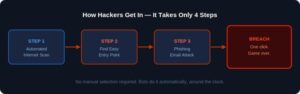
The 4-step attack cycle, fully automated, fully relentless.
How Modern Threats Slip Past Traditional Defenses
Basic antivirus and a standard firewall used to offer reasonable protection. Today, that approach is not enough. Here is how attackers layer their tactics:
Credential Stuffing
If an employee reuses passwords across platforms and one account is exposed elsewhere, attackers automate login attempts against your systems using known combinations at massive scale. Over 15 billion stolen credentials are currently in circulation on dark web marketplaces.
Business Email Compromise (BEC)
Criminals study company hierarchies and impersonate decision-makers to request urgent wire transfers or sensitive documents. No hacking required just trust and urgency. BEC attacks cost businesses over $2.9 billion in 2023 alone, according to the FBI.
Application Weaknesses
Web portals, payment forms, and customer dashboards often contain minor coding flaws. Those flaws become entry points. Once inside, attackers look for ways to escalate quietly often remaining undetected for an average of 204 days before discovery.
Ransomware & Double Extortion
Modern ransomware doesn’t just encrypt your files attackers first exfiltrate your data and threaten to publish it publicly unless you pay. This ‘double extortion’ approach means backups alone are no longer sufficient protection.
Supply Chain Attacks
Attackers increasingly target the software vendors, managed service providers, and third-party tools that your business depends on. A single compromised update or integration can expose dozens or hundreds of downstream businesses simultaneously.
What You Can Do Before a Breach Forces Your Hand
Waiting for a breach to expose your weaknesses is one of the most expensive mistakes a business can make. By the time you realize something is wrong, the damage is already unfolding data loss, financial impact, and reputational damage. Cybersecurity doesn’t start with complex tools. It starts with doing the fundamentals right, consistently.
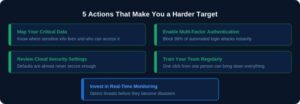
Five actions that dramatically reduce your exposure to cyber threats.
Map Your Critical Assets
Everything begins with visibility. If you don’t know what systems you have or where your sensitive data lives, you cannot protect it properly. Most organizations have more exposed assets than they think old subdomains, unused servers, publicly accessible storage, or test environments left open. These often become the easiest entry points for attackers. Understanding your environment and restricting access to only what is necessary immediately reduces your attack surface.
Enable Multi-Factor Authentication
Passwords are no longer enough to protect systems. They get reused, leaked, and stolen through phishing attacks all the time. Attackers don’t need to “hack” anything if they can simply log in. Adding multi-factor authentication creates an additional barrier that stops most automated attacks, even when credentials are compromised. It’s one of the simplest controls, yet one of the most effective.
Harden Your Cloud Environment
As more businesses move to the cloud, misconfigurations have become a major source of breaches. Public storage, excessive permissions, and exposed access keys can unintentionally make sensitive data available to anyone. These are not advanced vulnerabilities they are simple mistakes that attackers actively look for. Regularly reviewing access controls and ensuring everything is private by default can prevent serious incidents.
Train People as Seriously as Systems
Technology alone cannot stop cyberattacks. Many breaches start with a simple human action clicking a malicious link or trusting a fake request. Attackers exploit trust more than they exploit systems. When employees are trained to recognize suspicious behavior and feel comfortable reporting it, they become a strong line of defense instead of a weak point.
Invest in Real-Time Monitoring
No system is completely secure, which means detection is just as important as prevention. Without monitoring, attackers can remain inside your environment for long periods without being noticed. With proper logging and alerting, suspicious activity can be identified early, reducing the overall impact. The faster you detect a problem, the easier it is to contain.
The Bottom Line
Your business does not need to be famous to attract attention from attackers. Automated scans, phishing campaigns, and evolving cyber threats have already placed you on the radar. Cybercriminals look for easy opportunities don’t let yours be one of them.
Is your business prepared?